
From Ravines to the Lakefront: Hidden Geographies of Wilmette

On the surface, Wilmette feels like a classic North Shore village — tree-lined streets, lake breezes, and a rhythm of life that’s calm yet connected. But beneath that familiar charm lies a landscape shaped by forces far older and wilder than the town itself. The ravines, bluffs, and shifting shoreline that define this stretch of Lake Michigan are reminders that even in the most cultivated environments, nature continues to carve its quiet influence.
Long before Wilmette’s neighborhoods took root, the land was sculpted by melting glaciers that poured into the basin we now call Lake Michigan. As water levels rose and receded, they etched deep ravines along the North Shore — natural drainage paths that became lush corridors for wildlife and shelter for native plants. Many of these ravines still trace the village’s edges, hidden behind homes and winding trails, carrying seasonal streams down to the lake.
For those who walk Wilmette regularly, these subtle elevations are easy to miss until you feel them — the gentle dips near the Baha’i Temple, the rolling contours of Gillson Park, the slight descent as Sheridan Road curves toward the water. Together, they create a landscape that breathes: one that rises and falls with the memory of the lake’s ancient reach.
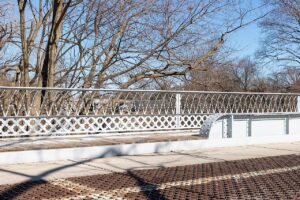
This interplay of form and flow finds a modern echo at Optima Verdana®, where architecture and landscape are designed to feel continuous. The building’s lush, layered terraces recall the vegetated slopes of the ravines themselves — green planes that step gradually toward light and air. Planters overflow with life, softening the structure’s modern lines and creating microhabitats that respond to sun, wind, and season. The result is not a separation from nature, but a reimagining of it within a contemporary residential community setting. In every sense, the building participates in the living landscape of Wilmette rather than merely occupying it.
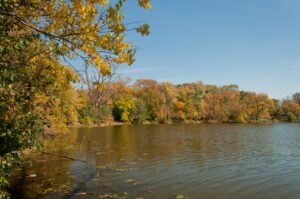
Step out from Optima Verdana® and within minutes you’re part of that larger terrain. To the east, the bluff at Gillson Park offers one of the region’s most striking views — a broad sweep of blue where the lake meets the sky. Walk north, and the ravines of the neighboring towns deepen, leading toward the shaded woodlands of the Skokie Lagoons. Each turn of the path reveals a different facet of the same story: a community shaped by the meeting of land and water, permanence and change.
In a place like Wilmette, architecture cannot help but converse with its surroundings. The balance of modern structure and organic form, of shelter and openness, mirrors the natural equilibrium of the North Shore itself. At Optima Verdana®, that dialogue is constant — between glass and greenery, shadow and light, interior and horizon.
It’s this connection to the land’s hidden geographies that makes life here feel so deeply rooted. From the ancient glacial traces beneath your feet to the living terraces above, Wilmette invites you to dwell in rhythm with nature — to inhabit a landscape that, even now, continues to evolve.


Latest Articles

Optima Connect, and the Perks Worth Having

Optima Verdana: A Studio of Its Own, Yoga and Pilates
